Crust Fractures Tokyo's Pizza Wars
A man in Nakameguro makes two pizzas. Only two. Down the street, someone is putting blackthroat seaperch on a Neapolitan crust. Across town, an American brewery is selling deep dish by the slice. Tokyo is arguing about pizza, and after seven years here I've finally picked a side.
I'm standing at a counter in Kanda on a Friday night, holding a slice of Detroit-style pepperoni pizza in one hand and a craft IPA in the other, and I'm aware that I look ridiculous. Nobody eats standing up in Japan. Or rather — people eat standing up at tachinomiya all the time, but they're eating dried squid and drinking nihonshu, not folding a slice in half like it's two in the morning in the West Village. The salaryman next to me is doing the same thing, though, so maybe the rules are changing. Or maybe pizza has always been the exception.
Here's what I've figured out after seven years of eating pizza in Tokyo, which is a sentence I never expected to write and which the Italian-American side of my family (Brooklyn stock, Long Island now) would consider grounds for an intervention: this city has, against all geographic and cultural logic, become one of the great pizza cities on earth. And the question of what that means (what Tokyo pizza is, exactly) has cracked open into a fight that's more interesting than any pizza fight I've seen anywhere, including New York, which has been having the same argument since 1905 and is frankly getting repetitive about it.
Three factions. They share a city, sometimes share a neighborhood, occasionally share flour suppliers. But they don't share a philosophy. And the tension between them, polite and Japanese, conducted through menu choices rather than open hostility, is producing some of the most compelling pizza on the planet.
The Purists Make Two Pizzas, and Only Two
The first time I ate at Seirinkan, I didn't know what I was walking into. I just saw a weird Gothic building in Nakameguro with a spiral iron staircase and the Beatles playing loud enough to hear from the street. Inside, a man named Susumu Kakinuma was feeding Japanese hardwood into a brick oven and making two pizzas. Not two kinds. Two. Margherita and marinara. That's the menu. That's been the menu since the place was called Savoy, back in 1995, when Kakinuma came back from a year of eating his way through Naples (no formal apprenticeship, just a notebook and what I imagine was an alarming appetite) and decided he knew enough to build something.
His innovation was subtraction. Japanese wood instead of Italian. A wallop of salt in the crust that would make a Neapolitan purist wince. Sixty seconds in the oven. The crust comes out with a quality the Japanese call sakusaku (サクサク) — a word that does better work than "crispy" because it's made of sound: layers giving way one after another, each collapse audible. "Crispy" tells you the texture. Sakusaku lets you hear it.
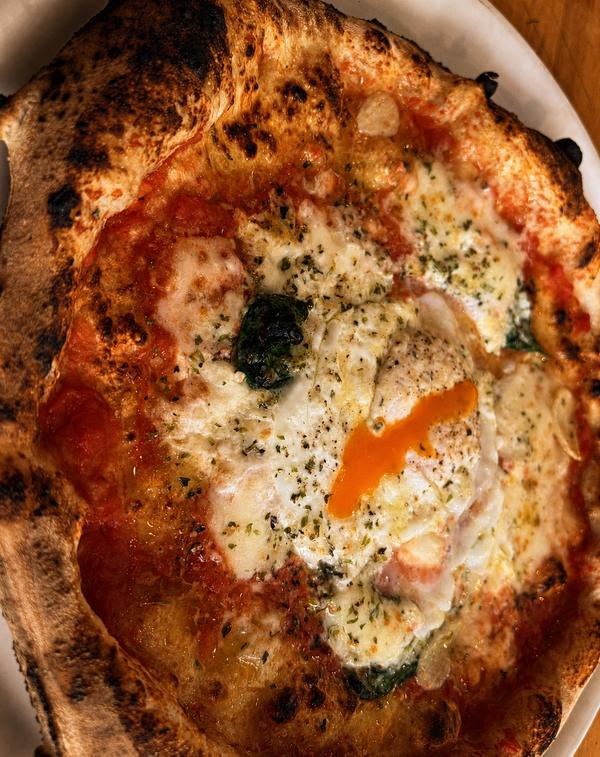
Kakinuma's students scattered across Tokyo and formed what you might call the Savoy diaspora. Tsubasa Tamaki at PST in Higashi-Azabu, now a Michelin Bib Gourmand holder who has begun exporting the style overseas, Manila first. Shogo Yamaguchi at Frey's Famous in Roppongi, where he begins each morning by throwing salt into his oven in a Shinto purification rite. Kengo Inoue at Pizza Dada in Kamakura. Daisuke Nakamura at BACAR in Okinawa. Each evolved the master's technique, but none abandoned his core conviction: fewer ingredients, more mastery.
Running parallel to the Savoy school is the formal Italian lineage. Hisanori Yamamoto, a pizzaiolo who trained not by eating in Naples but by competing in it, won the World Pizza Cup and now runs Pizzeria e Trattoria da ISA in Nakameguro, pushing out six to eight hundred pies a day with AVPN certification. Giuseppe "Peppe" Errichiello's RistoPizza by Napoli sta ca took the 50 Top Pizza Asia-Pacific number-one spot in 2026.
"While Neapolitan pizza is chewy and soft, Tokyo-style pizza is crisp, airy and light."
What unites these chefs, despite the Savoy school's insistence that their pizza is emphatically not Neapolitan, is a belief that simplicity is the whole bet. The menu is the message. Two pizzas or four, never thirty. The oven does the talking. The crust is the argument. To add a topping is to concede a point.
The Insurgents Came With Deep Pans
For most of its life in Tokyo, "American pizza" meant delivery chains (Domino's, Pizza Hut, Pizza-La) whose relationship to craft pizza is roughly what convenience-store onigiri is to the counter at Jiro. Functional. Not the point. That started to change in 2011 when DevilCraft opened in Kanda with a proposition that would have given the Savoy school heart palpitations: Chicago-style deep dish. Three types of cheese on the bottom, toppings in the middle, marinara on top, the whole thing dense enough to qualify as architecture. I remember my first slice there. You don't fold a deep dish; you go at it with a knife and fork and a certain amount of respect for its structural integrity. I sat there thinking, okay, this isn't what I came to Tokyo for, but this is good.
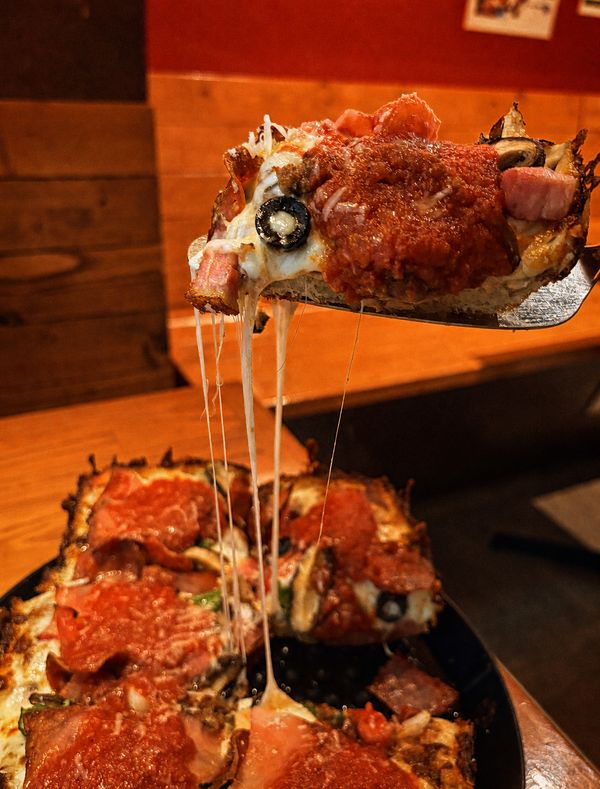
DevilCraft now runs five Tokyo locations, including Devil's Corner in Kanda, which serves Detroit-style pizza by the slice. That last part matters. The slice, that quintessentially New York unit of consumption, barely exists in traditional Tokyo pizza culture, where individual pies are the norm and you sit down to eat them. Selling by the slice is a cultural statement as much as a culinary one. It's how I ended up standing in Kanda on a Friday night, eating with my hands, looking ridiculous, feeling right at home.
Pizzakaya in Roppongi pushes further into American territory: California-style and Detroit-style pies, 48-hour fermented dough, gluten-free options, another concept essentially absent from the traditionalist playbook. Their vodka-sauce pizza would be legible in Brooklyn. Their green tea IPA would not.
And yet. DevilCraft's World Beer Cup gold medals lend the operation a seriousness that the purists can't easily wave away. There's also a telling irony that nobody in the traditionalist camp seems eager to discuss: Kakinuma himself was an outsider who ignored Neapolitan orthodoxy to build something new. The American-style shops are doing exactly the same thing to him.
The Heretics Put Sea Urchin Where the Tomato Goes
If the traditionalists worship subtraction and the Americans worship accumulation, the third faction worships surprise. These are the people who put nodoguro (blackthroat seaperch, a fish so luxurious it usually shows up at sushi counters where the omakase starts at 30,000 yen) on a pizza and call it lunch. Who treat mentaiko (spicy cod roe) not as a garnish but as a base sauce, spiraled across the dough where tomato used to be. Who see no contradiction in shirasu (baby sardines), uni (sea urchin), or mochi atop a Neapolitan-heritage crust. The first time I saw mochi on a pizza I thought someone was having a laugh. Then I bit into it. The cheese pulled one way and the mochi pulled the other, this mochimochi (もちもち) tug that had no business working and absolutely did, and I stopped laughing.
The thing that makes this faction fascinating is where it came from. Not outsiders. Not rebels. It emerged from inside the Savoy lineage itself. When Savoy Azabu-Jūban reopened in 2023 as three counters (Savoy Classic, Domi-La, and Woodstock Tokyo), it was the Savoy group's own decision to hand Domi-La over to experimental pizza. Walk in, turn left, you get margherita and marinara from the same dough Kakinuma has been making for thirty years. Turn right, you get nodoguro pizza, the oily fish draped across the crust with the casual authority of something that knows it costs more than everything else on the plate. The schism isn't between rival houses; it runs straight through a single one.
The tuna pizza might be the single most written-about pie in Tokyo, thanks to David Chang putting it on Ugly Delicious. Sushi-grade bluefin piled raw over the pie and barely kissed by the oven, so you get zones of char and cool rawness in the same bite, with wasabi on the side. I went in ready to find it overrated — a famous-on-TV dish carries that suspicion — and left annoyed at how good it was, which is the most reliable sign I've got that something deserves the noise.
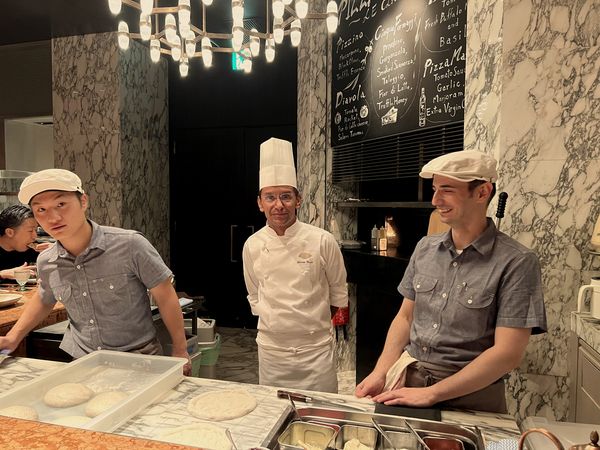
The most expensive heresy in the city is eight seats on the 38th floor of the Mandarin Oriental, where a Roman named Daniele Cason runs an omakase counter — and yes, I hear it, omakase pizza, the phrase alone would make a Neapolitan weep. I've sat at it. Cason works through eight pizzas in a single meal, a slice of each handed down the counter as he goes, the toppings climbing from legible to deranged and back. Roman technique in the dough, tasting-menu theater in the sequence. It held the top of the 50 Top Pizza Asia-Pacific rankings for three years running.
The Purists perfected their argument and then it was over. The Heretics are still arguing, mid-bite, with the crust itself.
The chains, meanwhile, have pushed even further, with the cheerful disregard for boundaries that only a non-artisanal operation can afford. Menus across Tokyo's delivery and casual-dining pizza scene rotate seasonally in ways that would baffle an Italian nonna: sakura shrimp in spring, maitake in autumn, grilled oysters in winter. Squid ink replaces tomato sauce, turning the pie black. Kewpie mayonnaise, Japan's tangy-sweet condiment of the gods, spirals across everything. Natto shows up on pizza menus at izakayas that serve it as late-night drinking food, which is either an abomination or a revelation depending on where you stand on fermented soybeans. (I stand firmly on the side of revelation, but I understand why reasonable people disagree.)
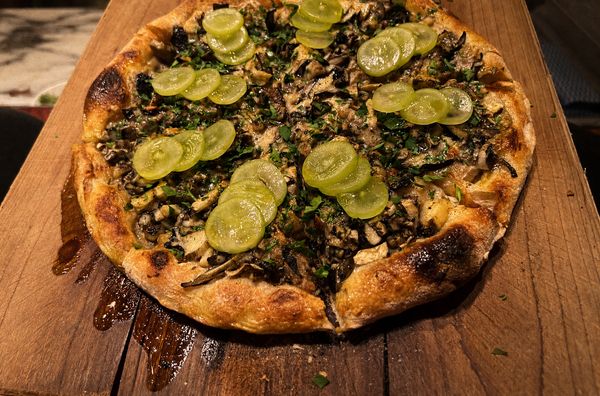
L'Insieme in Kameido has quietly become the bridge between all three factions. Chef Shunsuke Matsumaru never trained in Italy. His Michelin Bib Gourmand operation serves classic margherita alongside a white pizza topped with mozzarella, sausage, and french fries: Neapolitan technique, American spirit, Japanese precision, all on one plate. La Tripletta in Nakano keeps a rotating roster of thirty-plus pies, including a Rosa Marina with 'nduja and Shizuoka Prefecture whitebait, and a Diego (named after Maradona) that piles tuna, red onion, and spicy salami over a margherita base. I've worked through more of that menu than I'd care to total up, which is either devotion or an indictment of my diet.
I Know Which Side I'm On
I've been playing this even-handed for about two thousand words, and I should quit. I eat at all three. But I only cook like one of them.
Ever since I moved here, the food I make at home has drifted somewhere those Long Island relatives wouldn't recognize. Sansho carbonara, the Japanese mountain pepper's citrus and its slow electric numbness coming up through the egg and the pork fat. Sansai quesadillas, foraged mountain vegetables that taste like a wet forest floor, folded into melted cheese on a flour tortilla. None of it is correct. Some of it is a mistake. I keep doing it anyway, because the cooking that has ever interested me lives at the seam where two things with no business meeting get talked into it.
So when I tell you the Heretics have it right, fine: I'm grading my own homework. But here is what they understand that the Purists don't. A perfected thing is a finished thing. Kakinuma made his two pizzas about as well as two pizzas can be made, and then the only move left was to make them again tomorrow, and the day after that. There's greatness in it. There's also an ending in it. A crust you've perfected is an argument you've won, and a won argument is over.
The Heretics never let it be over. Nodoguro this month, uni the next, mochi after that, and the question of what the thing even is stays open on purpose. It isn't novelty for its own sake. Plenty of the chain stuff is exactly that, squid ink and Kewpie sprayed around because it photographs well. The shops I care about are doing something harder, which is refusing to stop asking. And they earned the right to ask: Domi-La can break Kakinuma's form because it is built out of Kakinuma's form. That's the real kata-yaburi, literally "form-breaking." You can only break what you actually learned, and the Heretics learned it on the same dough as the Purists before they turned and walked the other way.
Here's the part I can't argue you into, only describe. I drink muroka nihonshu, the cloudy unfiltered kind, and Belgian beers fermented with whatever wild yeast wandered into the barrel, and I love them both for the same disreputable reason. They're never the same twice. This year's bottle isn't last year's. Something alive got in and made decisions the brewer never signed off on. Almost everything you can buy is engineered to taste identical forever; these two refuse, and the refusal is the whole pleasure. The Heretics' pizza tastes like that to me. Unstable. Never quite the same plate twice.
I'll give the Purists their due, because it costs me something to land here. They are usually the better single meal, and the scoreboard tends to agree: this year's 50 Top Pizza Asia-Pacific number one went to a Neapolitan purist, and most of the crust-as-canvas shops sit well below him. Fidelity is measurable; surprise isn't, and a ranking rewards what it can measure. Though the three years before this purist took the top, the board belonged to Cason's eight-pie omakase — which complicates the speech I'm trying to give. On a given Tuesday, with one meal to spend, I might still reward the sure thing. The Heretics fail more often than the Purists. They just fail in the one direction I find worth watching.
Last Saturday I had the nodoguro pizza at Domi-La, next to a couple who had come in from Osaka just for it. The fish lay across the crust with the casual authority of the most expensive thing in the room. Two bites in, I couldn't have told you whether I was eating pizza or aburi sushi on a flatbread, and by the third bite I'd stopped needing an answer. I went home that night and stood in front of the open fridge for a while, working out what I was going to put the sansho on next.